This post is also available in:
 Français
A report by Goldman Sachs published in April 2026 suggests that technological shocks can create short and long term income losses and longer transition periods for exposed workers (developers, translators, illustrators…). In this context, we need to take back control of our lives ASAP by changing our relationship with money, living consciously, spending less without depriving ourselves, while still feeling a sense of abundance.
I have the perfect book to help you change your mindset! “Your Money or Your Life: 9 Steps to Transforming Your Relationship with Money and Achieving Financial Independence”
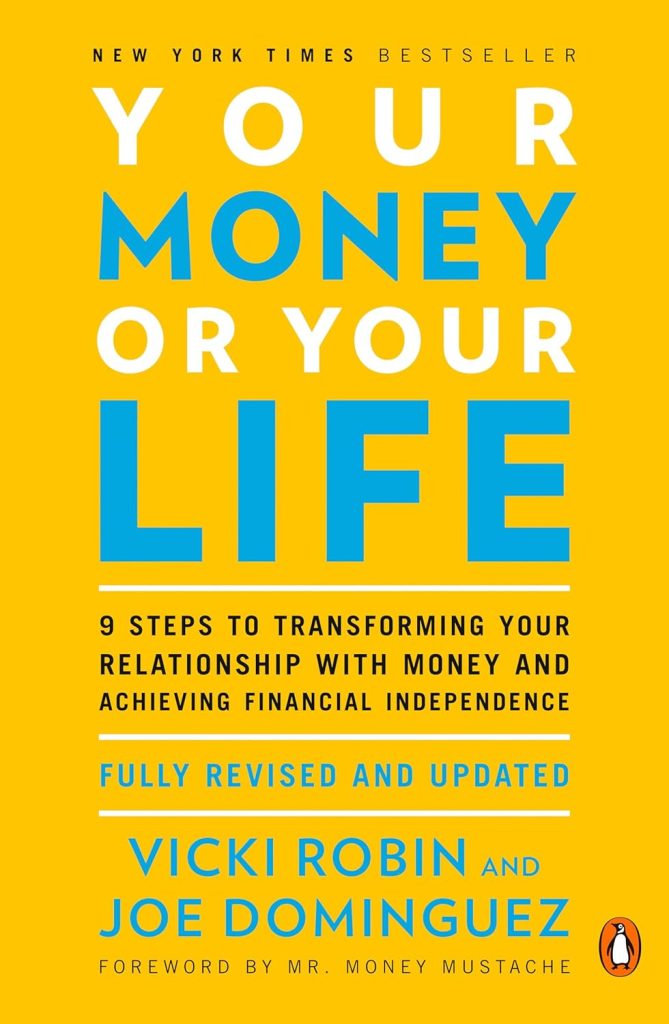
This book is at the origin of the FI movement (Financial Independence), which later became FIRE (Financial Independence, Retire Early). Written in 1992 and updated in 2008, it is often the first read for employees aiming for FIRE (entrepreneurs aiming for FIRE tend to read Tim Ferriss instead (Amazon link).
You can buy the book on Amazon. The investment strategies in the book are for americans and not adapted to Europe, so I recommend to read other investment books related to your country.
Life energy: our real currency
The core concept of “Your Money or Your Life” is based on a radical realization: money is not an end in itself, but simply something we exchange for our life energy. This life energy represents the hours of our lives, a limited and irreplaceable resource. Unlike money, which can be earned and spent endlessly, our time on Earth is finite.
This perspective radically transforms our relationship with consumption. Every purchase becomes a conscious decision: how many hours of my life am I willing to trade for this object or experience? The problem is that most of us have no idea of the true cost in time of our spending, because we do not know how to calculate our real hourly wage.
Calculating your real hourly wage: a painful revelation
The exercise proposed by the authors is both simple and eye opening. It involves calculating not your gross or even net salary, but your true hourly earnings by taking into account all the hidden costs related to your job. Take the example of someone who thinks they earn 25€ per hour. On the surface, that seems like a good salary. But let us look closer.
This person officially works 40 hours per week, but in reality spends much more time and money on their job.
- The commute takes 1.5 hours per day, or 7.5 hours per week, with fuel and maintenance costs of 100€ per week.
- Dressing appropriately for the office requires a specific wardrobe costing about 25€ per week averaged over the year.
- Lunches out and coffee breaks add another 50€ per week.
- After work, it takes 5 hours to truly unwind and recover from stress, often with a beer or a glass of wine (30€ per week).
- On weekends, “compensatory leisure” activities to forget the tough week add another 40€.
- Not to mention vacations, massages, therapy, and other stress related costs.
In the end, this person actually works 70 hours per week (40 official hours plus 30 hours of job related time) for a net income of 700€ (1000€ salary minus 300€ job related expenses). Their real hourly wage is therefore not 25€, but 10€ per hour. Every euro spent represents 6 minutes of life. This new calculation changes everything: that 80€ outfit? That is 8 hours of your life. That 120€ restaurant dinner? 12 hours of work. That 30,000€ car? 3,000 hours, more than a full year of your life if you only worked, slept, and ate.
The nine steps to financial independence
The program proposed by the authors includes nine progressive steps:
Step 1: Make peace with the past
This first step consists of establishing two essential numbers. First, calculate how much money you have earned over your entire life, from your first euro to today. Second, calculate your current net worth. This exercise is extremely time consuming, so you can do it after reading the book to avoid discouragement.
Step 2: Be present, track your life energy
This step has two parts. First, calculate your real hourly wage as explained earlier. Second, and this is crucial, track every single cent that comes in or goes out of your life.
By doing a full “accounting review” of everything I spent and sold on Vinted, I realized that “small” purchases added up to several thousand euros per year, and I deleted the app in one minute.
Step 3: The monthly table, where does the money go
Each month, you create a summary table of all your expenses, grouped into categories that reflect your real life. Forget standard budget categories. Create your own categories and subcategories that tell your story. For example, food can be split into: “family meals at home”, “restaurants”, “invitations”, “snacks in front of TV”, “coffee breaks at work”.
The magic of this step is converting euros into hours of life. If you truly earn 10€ per hour and spent 150€ on restaurants this month, that equals 15 hours of your life. This changes everything. That 40€ dinner becomes “4 hours of my life”. Is it worth it? You decide.
Step 4: The three life changing questions
For each expense category, ask yourself three key questions:
Question 1: Did I receive fulfillment, satisfaction, and value proportional to the life energy spent?
Question 2: Is this expense aligned with my values and life purpose?
Question 3: How would this expense change if I did not have to work for money?
Step 5: Make life energy visible
Create a large chart showing your income and expenses over time. Trends will emerge and change your behavior.
Step 6: Value your life energy, reduce expenses
This step is about intelligent frugality: maximizing satisfaction while minimizing spending. Buy consciously and resist manipulation from marketing.
Step 7: Value your life energy, increase income
If money equals life energy, you should seek the best return for it. This is about self respect, not greed.
Step 8: Capital and crossover point
When your investment income exceeds your expenses, you reach financial independence.
Step 9: Invest for financial independence
You must invest your money to preserve purchasing power instead of letting it sit idle.
Beyond money: natural wealth
Financial independence is only one pillar of true wealth. The more you develop your skills, your relationships, and your sense of community, the less money you need to live well. And the less money you need, the faster you reach financial independence.
The fulfillment curve: finding “enough”
A concept that comes up often in Lao Tzu is having “enough.” This concept is also developed in this book through the “fulfillment curve.” At first, more things equal more happiness: you are cold, you get a blanket, you feel better. You are hungry, you eat, you feel better. But at a certain point, at the top of the curve, you have enough. Enough food, enough clothes, enough comfort. Beyond that, fulfillment starts to decline. The problem is that our society has taught us that we never have enough. “More is better” is the mantra. But research shows that after a certain income level, around 75,000 dollars a year in the United States, more money does not bring more happiness. Finding your own “enough” is revolutionary. It means you can stop the rat race.
Money and the planet: the ecological impact of our choices
The book emphasizes that every euro spent represents not only your life energy, but also the planet’s resources. Every product you buy required raw materials to be extracted, transported, manufactured, and distributed, and all of that has an ecological cost. The good news is that financial independence and ecological sustainability go hand in hand. You save money and help save the planet at the same time.
My review: pros
This book is aimed mainly at employees, whereas I was used to reading FIRE books that were more entrepreneur oriented. The emphasis is therefore much more on frugality than on “earning more.” Personally, I have always found it easier to increase my income than to cut my expenses, so this book really pushed me into a different way of thinking. Thanks to it, I found concrete ways to spend less without feeling frustrated, simply by changing the way I see money. Its method for calculating the “effective hourly wage” and then converting each expense into hours of life made a strong impression on me. It is a bit like the movie In Time, where every purchase is equivalent to a certain number of hours lived or lost. You quickly realize that for the poorest employees, 8 hours at work often barely covers the cost of the rent, bus, food. Seeing your expenses translated into “hours of your life” completely changes how you see what you call a “small purchase.”
The examples are numerous, very concrete, and often very encouraging. It is really typical of American self help style: you finish the book highly motivated, with the urge to rethink everything and start over differently.
It also speaks very well to the idea of “enough” cherished by Taoist philosophers. It helps us ask the right questions: how much is truly enough? How do we find our own threshold of sufficiency? And how do we reach it?
My review: cons
It is an old book, even if it has been updated with more recent data (2008). The style still feels quite dated, long, and sometimes heavy, which explains why the reader may take several naps before reaching the end.
The book contains a lot of numbers and tables, which can quickly discourage people who are not comfortable with the accounting side of financial planning. For others, on the contrary, this very quantitative approach is highly motivating.
Finally, it is a very basic introduction for future FIRE followers. If you already know the movement well, you may find it a bit elementary. This is especially true for investing: the solutions proposed are based on the American market and adapt poorly to European reality. The sections on debts mainly speak to American readers, while the European credit system and social protection system are different.
You therefore need to complement this reading with other books focused on investments adapted to the European context. Even so, it is an excellent introduction to the FIRE movement, especially for those who fear they will not know how to fill their days once financially independent, or who have always seen the movement as something for “lazy people.” This book shows that financial independence is not about avoiding work, but about living better.
You can buy the book on Amazon. The investment strategies in the book are for Americans and not adapted to Europe, so I recommend to read other investment books related to your country. For France, I recommend this book
This post is also available in:
Français