This post is also available in:
 Français
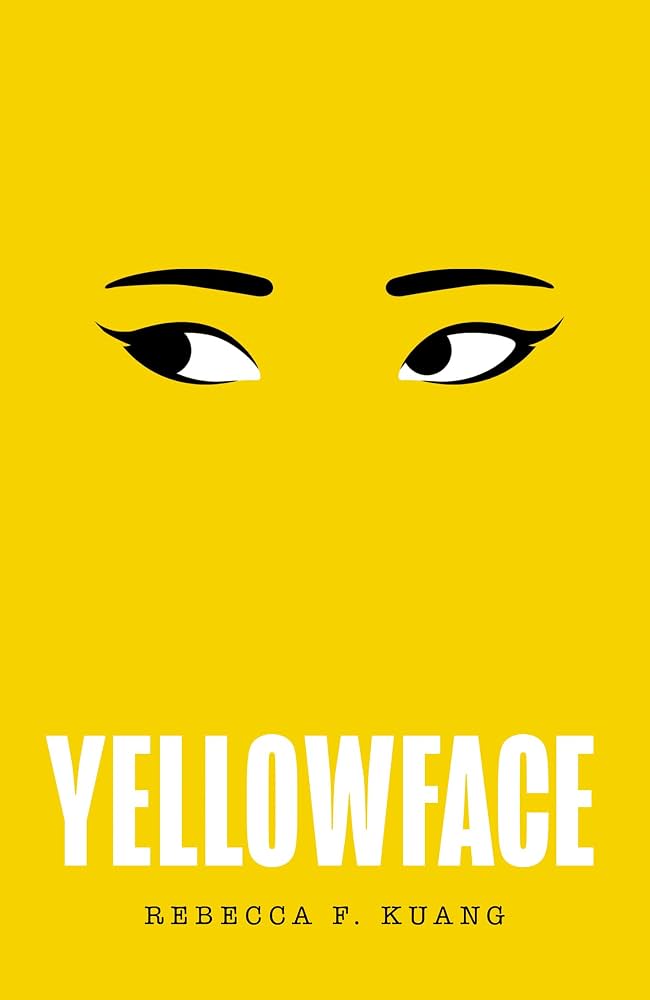
The book Yellowface (Amazon link, Fnac link) has a simple yet effective cover. I saw it in every bookstore, both in the US and in London. When a book gets too much buzz, I tend not to read it right away. I let some time pass. When it first came out, it was riding the wave of the cultural appropriation debate, which doesn’t interest me in the slightest, so that’s why I didn’t buy it.
It came up again in my bookworms groups this year, and I discovered a more interesting aspect of the book: people who feel victimized by other people’s success. People who think others are stealing opportunities that should have been theirs. Yet they don’t necessarily question their own shortcomings.
I was even more motivated to read it after watching Rebecca F. Kuang’s interview on YouTube: her rich, precise vocabulary and interesting literary references really stood out to me. I have just demonstrated the very thing the author criticizes: we decide to read a book because we’re interested in its author. I devoured the book in one evening.
THIS IS ONE HELL OF A STORY.
IT’S JUST NOT HERS TO TELL.When failed writer June Hayward witnesses her rival Athena Liu die in a freak accident, she sees her opportunity… and takes it.
So what if it means stealing Athena’s final manuscript?
So what if it means ‘borrowing’ her identity?
And so what if the first lie is only the beginning…
Finally, June has the fame she always deserved. But someone is about to expose her…
What happens next is entirely everyone else’s fault.
What’s interesting is that the story is told from June’s perspective, even though she’s the antagonist. And hers is the only point of view we get throughout the entire novel. This insufferable, petty voice is what we call an “unreliable narrator”: someone who can lie, omit information, get things wrong, distort the facts, or, above all, interpret and justify events in a biased way.
Warning! Spoilers from this point onward.
We’re tempted to distance ourselves from this despicable character, but little by little, she leads us around by the nose. By the end of the novel, after her rather convincing anecdote (backed up by Athena’s ex), we find ourselves thinking that Athena was a bit of a bitch too… and we almost want June to get away with her lie. But karma always catches up. If June is jealous of Athena, other people are jealous of June’s success.
The beginning focuses on the rivalry between a loser and someone who seems to have everything for her. The problem with envious people is that they think they’re constantly being victimized. June endlessly compares the way Athena is treated (by publishers, agents, critics…) with the way she’s treated herself. And yet June has had a book published! (How many writers would dream of having a book published!!) And June went to Yale too! June has slightly fewer financial resources than Athena, but that doesn’t change anything about Athena’s success. Objectively speaking, June even acknowledges that Athena is more talented. The proof? When June submits Athena’s stolen manuscript, the book is welcomed with open arms. In other words, talent can get you somewhere after all. June could cry injustice if Athena’s text were rejected despite being submitted under June’s name. Then, yes, we might have concluded that a text gets accepted or rejected based on the author’s identity. But no: the text is accepted because of its quality. Instead of thinking, “Maybe I was treated badly before because my first manuscript was pretty weak,” June refuses to reconsider anything about herself and carries her hatred of Athena all the way to the last page.
This is the novel’s main weakness: the manuscript June plagiarizes should have been rejected by her agent and the publishers. That would have been the perfect critique of the publishing industry: certain authors are favored, rather than the writing itself. J.K. Rowling actually put this idea to the test when she published The Cuckoo’s Calling under the pseudonym Robert Galbraith. The book only sold around 1,500 copies in the UK during its first three months, before her identity was revealed. Once people discovered that Robert Galbraith was actually J.K. Rowling, sales skyrocketed.
What I really like to see is that even someone who is clearly more privileged (because white privilege is undeniable) can still find arguments to justify feeling victimized. This resonates with me personally, because the people who wanted to hurt me weren’t, contrary to what you might expect, people who had less than I did. On the contrary, they were women who were much prettier, smarter, and richer than me. And yet they still managed to find some little thing I had that made them feel threatened by me (an immigrant, all alone in France, without a single luxury brand item on me). It’s crazy! I read the novel to understand people like that. I think that when you realize someone with a lower social status than yours gets something you believe you should have received, but didn’t because you lack talent, haven’t worked hard enough, or whatever, it’s incredibly difficult to accept. How can you acknowledge your own shortcomings in front of someone you consider socially inferior? Instead of questioning yourself, you pick apart everything that’s wrong with the other person and make them THE person responsible for your suffering. You’re the victim. That’s it.
P.S. The author mentioned Ugly Feelings by Sianne Ngai and Gone Girl as inspirations. I skimmed the chapter on “Envy” in Ugly Feelings. It reads like an academic thesis and is very difficult to get through. What I took away was the idea that envy is categorized as a feeling to be suppressed and condemned because it implies that the envious person is “inferior,” that they are “lacking,” and that they want to possess, imitate, devalue, destroy, or take revenge on whatever the other person has. Envy is an “unhappy self-assertion.” Envy can also be used as a driving force in social struggles (eat the rich!). This is what supposedly justifies the growing attacks by North African gangs (I’m being extremely politically correct here) against Asian shopkeepers, on the grounds that “they’ve become too rich” (a Deutsche Welle investigation, broadcast on YouTube in January/February 2017, on assaults and robberies targeting Chinese immigrants in the Paris region). These gangs fail to realize that Asians start from a less advantageous position: they don’t speak French very well. According to these gangs, equality means being mediocre and poor together.
Then we get into the technical details of publishing a book. Since everything is still told from June’s point of view, she believes that a bestseller is manufactured rather than the result of work that deserves to be rewarded. She explains that even if an author is relatively unknown, if the publisher believes in them, it will invest all the resources necessary. She has to sign tons of books before publication, even though she was still an unknown author. Prominent placement in bookstores, competitions, social media campaigns… all of it costs money. An author doesn’t go viral out of nowhere for free. Then comes the criticism of censorship and the infantilization of readers: the author has to rewrite certain passages because readers might not understand them or agree with them, so some passages get “dumbed down.” Basically, Victor Hugo, in our day and age, would have had to cut his endless descriptions of Paris’s streets or the Battle of Waterloo.
Then there’s the fact that June, a white author, is jealous of the success of POC authors… which is rather comical. She claims that authors of color are highly marketable. In recent years, more and more white people (in the United States, at least) have resented POC for supposedly stealing their opportunities, or LGBT people for supposedly taking jobs away from them because companies have quotas for these groups. This is utterly ridiculous. Statistics continue to show that white people remain the majority in entertainment, literature, and other fields… The moment we try to give non-white people even a tiny quota, some people practically start talking about “reverse apartheid.”
The novel quickly turns into an ideological debate about cultural appropriation, the far right, and the left wing etc. And we discover that Americans really have too much time on their hands to waste on Twitter. When the novel came out, the cultural appropriation debate was in full swing: can a white person write novels about China? Can a Chinese American write novels about the Cultural Revolution? These passages are far too long and boring. It’s like reading Twitter comments and doomscrolling for an entire afternoon. We got the point, thank you. What’s really funny about the novel, and what I think is a clever idea, is that June (who is white) has stolen Athena’s manuscript (Athena is of Chinese descent). So people on Twitter criticize June for using dismissive, stereotypical language… even though the text was originally written by an actual Chinese woman. In other words, people criticized her because of her race, not because of the content of the book. Even Athena herself cannot escape being pigeonholed into a cultural category: the publishing industry reduces marginalized authors like her to spokespersons for their origins.
In any case, if a white author wants to write about Vietnam, there won’t be any problem. Almost 20 years ago, Yveline Féray, who has absolutely no Vietnamese ancestry, wrote two novels about famous Vietnamese figures: Dix Mille Printemps and Le Paresseux. Vietnamese readers didn’t criticize her at all. Quite the opposite: we loved her work! We’d never had historical fiction like that before. Her research was phenomenal! The explanatory notes she included taught me so much about my own country. We were in awe of the amount of work she had done. The fact that she was French and white actually gave her novels more weight and credibility in our eyes.
So the idea that Asians would take offense at white authors being interested in their cultures and bringing them to wider attention is a sign of a society that has too much free time and too few real problems. I’m almost embarrassed that I’ve spent so much time discussing this movement in this article. I’m sorry, I’m sorry! But it’s a major theme in the novel, which is why I had to address it.
The novel also highlights the harmful effects of reviews and comments posted on Amazon, Goodreads, and other platforms, which can destroy authors. I think criticism has always existed, but in the past, if you wanted to insult an author, you had to take out your fountain pen, write a letter, mail it, and find the publisher’s address… a lot of effort just to insult someone. Nowadays, all it takes is a smartphone and 160 characters. June can’t control herself: she reads the reviews and takes them personally (even though she shouldn’t, because the manuscript isn’t even hers in the first place. That’s the funny part).
All in all, I really enjoyed the first part about envy and jealousy. I also loved the question of whether June was justified in plagiarizing Athena, given that Athena was also a bit of a bitch who plagiarized in her own way.
I really enjoyed the sections about how books are published, promoted, and turned into money. I’d heard about bidding wars between publishers, but I didn’t know how they got started or how much time typically passes between acquiring the rights and publishing a book. The whole section about rewriting and “dumbing down” the text for the audience was fascinating! It only reinforces my desire to read fewer contemporary books and more classics. Apart from their length, perhaps (paper and printing used to be expensive), classics haven’t been revised and reworked to this extent.
I enjoyed the social media sections much less, because they’re the most visible part of the whole debate, the part everyone already sees. Nobody wants to read hateful tweets over and over again in a novel. If I wanted to read hateful tweets, I’d be on Twitter instead.
So I’d say that the novel loses steam toward the end. On top of that, I was reading it quite late at night, so all I wanted was for the ending to arrive quickly and wrap things up nicely. But it dragged on and on… And then we got a Proustian ending. Only much less effective, because you can see it coming from miles away, whereas with Proust, it arrives much more subtly.
Another point, which may be related to the whole “dumbing down” effect : I found the author incredibly eloquent in her interviews, with vivid, precise words… the kind of vocabulary you encounter on the SAT tests in the United States. But the novel’s vocabulary is much less sophisticated. I read it in English and expected to learn lots of new words. In the end, I only had to look up two words in the dictionary. What a disappointment! You could argue that the book is written from June’s perspective, so her vocabulary is less sophisticated than the author’s. But June is also a writer and an SAT tutor, so she could have had a better writing style. Sorry! The “dumbing down” effect is noticeable.
I quite enjoyed reading it. It’s not a book I’ll read again, but I’m really glad I read it. I highly recommend it, especially since the French paperback edition (Amazon link, Fnac link) is now available.
This post is also available in:
Français